COMPLETE DIGITAL EDITION · ONE-TIME PURCHASE ($9.99 USD) · NO SUBSCRIPTION · INSTANT DOWNLOAD
COMPLETE DIGITAL EDITION · ONE-TIME PURCHASE · NO SUBSCRIPTION

Stop Losing Two Hours a Day to Algorithmic Feeds—Without Willpower, Dumbphones, or App Timers.

Why every blocker you’ve tried backfired—and the behavioral-science playbook that dismantles the itch from the inside out.

Get Instant Access Now — $9.99 USD
100% Secure Encrypted Checkout · Instant PDF + EPUB Download · No Subscription
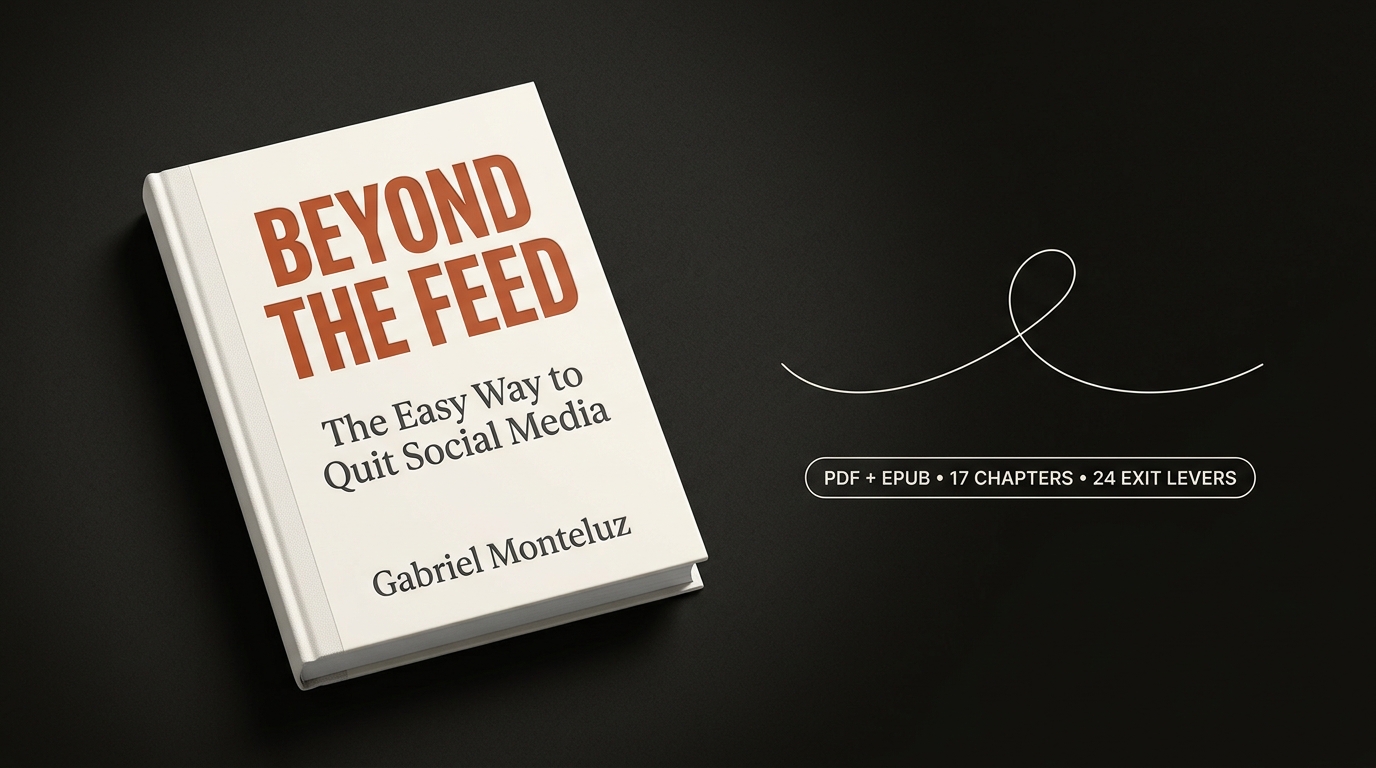
Beyond the Feed: The Easy Way to Quit Social Media
17 Chapters · 24 Practical Exit Levers · DRM-Free PDF & EPUB · Grounded in studies from American Economic Review, Nature & UC Irvine
Quick Self-Check · Does This Sound Like You?

Be Honest With Yourself for Ten Seconds

?Ever found yourself still scrolling past midnight when you swore you’d go to sleep an hour ago?
?Do you notice you don’t even enjoy social networks anymore—yet you keep returning to them anyway?
?Have you set a 15-minute daily app timer, only to tap “Ignore Limit” before lunch?
?Did deleting Instagram or TikTok just push you into scrolling YouTube Shorts or Reddit instead?
If you nodded to even one of these: you don’t have a broken willpower problem—you’re caught in an engineered behavioral loop. Here’s why it happens (and how to step out).

Real Questions Behind “How to Stop Scrolling”

Whether you are stuck in TikTok, Instagram Reels, YouTube Shorts, or late-night revenge bedtime procrastination, the trap runs on the same behavioral loop:

Sixty “harmless” two-minute phone checks a day quietly drain two full months of waking life every year—and shatter the calm required for deep work, reading, and real sleep.

Beyond the Feed takes the opposite route: instead of lecturing you to “have more discipline,” it exposes the exact illusions and UI hooks keeping the loop running—so stepping away feels natural.
Get Instant Access Now — $9.99 USD
Instant digital download · Read on Kindle, Apple Books, Kobo, tablet, or desktop

Two Complete Guides Inside One Edition

You get both the full psychological investigation and an engineering-style field manual you can reference any time an urge fires.

Part A · Full Book

17-Chapter Behavioral Deep Dive

  • The Two Monsters model (Neural Twitch vs. Mental Myth)
  • Systematic breakdown of all 7 feed illusions
  • Dedicated chapter on ADHD, dopamine & task-initiation dread
  • Day-by-day transition playbook for Days 1–14
Part B · Included Field Manual

The 24 Algorithmic Levers Appendix

  • Pull-to-refresh, variable-ratio queues & infinite scroll
  • Phantom vibrations, red dots & streak anxiety
  • Outrage amplification & passive-scrolling loneliness
  • Concrete countermeasure for every single lever

Complete Chapter-by-Chapter Breakdown

Everything waiting inside the book:

Introduction & Part 1: The Invisible Trap (Ch. 0–3)

  • The 21-Year Hook (2002–2023): How the internet evolved from a dial-up desktop with an off switch into a 24/7 pocket slot machine.
  • The Invisible Cage: How 60 brief daily checks destroy deep attention—and the Deactivation Paradox.
  • The Reflex and the Myth: Separating the automatic thumb twitch from the conscious excuse invented two seconds later.
  • The Engineered Itch: Why pull-to-refresh and infinite scroll obey the exact math of B.F. Skinner’s pigeon experiments.

Part 2: Dismantling the 7 Illusions (Ch. 4–10)

  • The Grip of Fear (FoMO): Why quiet silence triggers anxiety and why checking doesn’t cure it.
  • The Myth of Staying in Touch: Why passive scrolling correlates with higher loneliness, not closer friendship.
  • The Myth of Relaxation: Why 20 minutes on a feed leaves your mind heavier than 20 minutes working (Attention Residue).
  • The Myth of Staying Informed: Outrage funhouse mirrors vs. calm, high-signal information diets.
  • The Escape Hatch & The Scoreboard: Procrastination as short-term mood repair, social comparison, and crisis doomscrolling.

Part 3: Why Traditional Fixes Fail (Ch. 11–13)

  • The Willpower Trap: Why white-knuckling guarantees rebound thoughts.
  • Timers, Blockers & Substitutes: Scarcity psychology (cookie-jar effect) and why swapping Instagram for YouTube Shorts fails.
  • Different Brains (ADHD & Friction): Tonic vs. phasic dopamine, Russell Barkley’s point of performance, and desk physical scaffolding.

Part 4 & Appendix: The Exit Architecture (Ch. 14–17)

  • Architecture of the Exit: Keeping genuine tools (maps, messaging, work utilities) while cleanly amputating the algorithmic feed.
  • The First Two Weeks: Navigating Days 1–14 without feeling deprived when the phantom reflex still fires.
  • A Life Reclaimed + Appendix: Soft fascination attention restoration + all 24 Algorithmic Levers & Countermeasures.

Grounded in Peer-Reviewed Research — Not Self-Help Fluff

Each chapter isolates the empirical science in a dedicated Evidence breakdown:

American Economic Review (2020)

The Deactivation Paradox

Allcott et al. paid nearly 3,000 active Facebook users to deactivate for 4 weeks—and measured how sharply people had overestimated the feed’s value.

Organizational Behavior (2009)

Attention Residue

Sophie Leroy’s lab experiments proved that switching away—even briefly—leaves cognitive residue that degrades performance on the next serious task.

Neuroscience (Schultz & Berridge)

Wanting vs. Liking

Why dopamine prediction-error spikes drive compulsive checking even when you consciously realize you aren’t enjoying what’s on screen.

Clinical ADHD Research

Point of Performance

Why internal intentions collapse when a glowing cue sits two inches from your keyboard—and why changing physical distance beats willpower.

Who This Book Is For

  • Developers, writers, students, and knowledge workers losing mornings to “quick checks.”
  • Anyone with ADHD or high task-initiation friction who failed with app timers and blockers.
  • Readers who want research-backed mechanisms rather than preachy digital-detox guilt.

What Makes It Different

  • No forced dumbphones, account purges, or extreme isolation rules.
  • One-time purchase with both PDF and EPUB included—zero subscriptions.
  • Written by a software engineer who fought the loop for 21 years and broke out in 2023.

About the Author

Gabriel Monteluz is a software engineer who got his first dial-up PC at age 12 in 2002 and spent 21 years watching the intentional web turn into an attention casino. Living with ADHD friction and chronic work-avoidance loops, he tried dumbphones, grayscale filters, timers, and account deletions—failing repeatedly until he dismantled the illusions underneath the habit in 2023.

Everything Included Today for $9.99 USD

  • Full 17-Chapter Book (PDF): Publication-grade typography for desktop, tablet, or print.
  • Full 17-Chapter Book (EPUB): Formatted for Kindle, Apple Books, Kobo, and any e-reader.
  • Included Appendix: All 24 Algorithmic Levers & Practical Countermeasures field manual.
  • DRM-Free & Instant Download: Zero recurring subscriptions, zero account lock-in.
Get Instant Access Now — $9.99 USD

Frequently Asked Questions

How do I stop doomscrolling at night when I'm exhausted?

Nighttime scrolling happens when your tired prefrontal cortex looks for effortless mood repair. Chapter 6 and Chapter 14 show how to replace late-night feed loops with calm wind-down cues so sleep arrives naturally.

Why do iPhone Screen Time limits, grayscale mode, and app blockers fail?

External blockers create artificial scarcity (the Cookie-Jar Effect) without removing your desire to look, so you bypass the PIN or move to another app. Part 3 explains how to dismantle the craving itself.

Do I have to quit the internet or buy a dumbphone?

No. You learn the surgical boundary between genuine tools (maps, direct messaging, work utilities) and algorithmic feeds—digital minimalism without throwing away useful technology.

Is this a subscription?

No. It is a single one-time payment of $9.99 USD for both DRM-free PDF and EPUB files.

What is the return / refund policy?

Because this is an instant digital download with full DRM-free PDF and EPUB files delivered immediately, all digital sales are final (no returns or refunds). Not sure yet? Try the $0 Free Sample (Manifesto + Introduction PDF) first before buying.

Download Both PDF & EPUB Instantly

One focused read. No subscription, no DRM lock-in, and zero willpower lectures.

Get Instant Access Now — $9.99 USD
Get Full Book (PDF + EPUB) — $9.99 USD