How micro-checks fragment your working memory before deep work can even start—and the structural shifts that restore calm concentration.
The problem isn't laziness—it's task-initiation dread, fragmented working memory, and the hidden cost of digital burnout:
You sit down at your desk with clear priorities, hit ten seconds of tough mental friction—and suddenly twenty-five minutes are gone. Even after locking the screen, your brain stays foggy from Attention Residue.
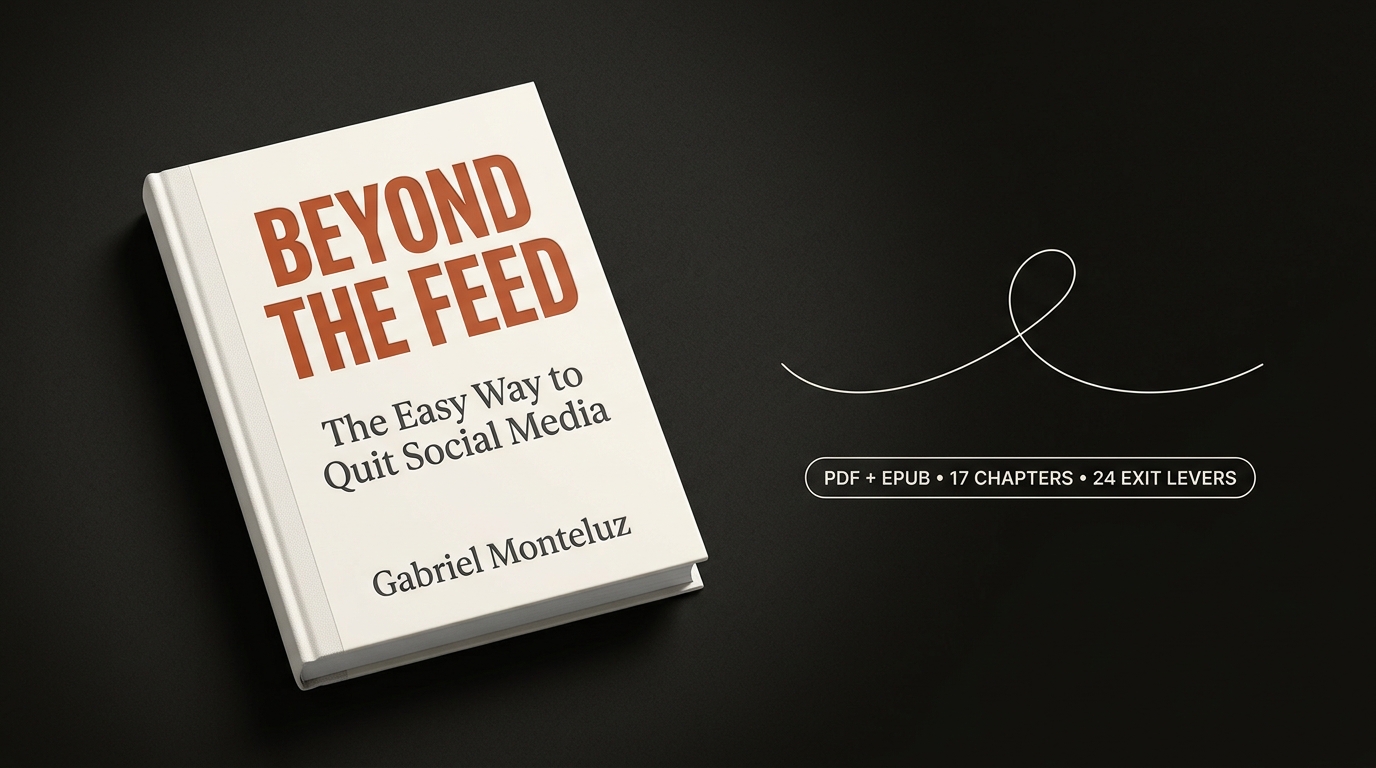
Beyond the Feed takes the opposite route: instead of lecturing you to “have more discipline,” it exposes the exact illusions and UI hooks keeping the loop running—so stepping away feels natural.
You get both the full psychological investigation and an engineering-style field manual you can reference any time an urge fires.
Everything waiting inside the book:
Each chapter isolates the empirical science in a dedicated Evidence breakdown:
Allcott et al. paid nearly 3,000 active Facebook users to deactivate for 4 weeks—and measured how sharply people had overestimated the feed’s value.
Sophie Leroy’s lab experiments proved that switching away—even briefly—leaves cognitive residue that degrades performance on the next serious task.
Why dopamine prediction-error spikes drive compulsive checking even when you consciously realize you aren’t enjoying what’s on screen.
Why internal intentions collapse when a glowing cue sits two inches from your keyboard—and why changing physical distance beats willpower.
Gabriel Monteluz is a software engineer who got his first dial-up PC at age 12 in 2002 and spent 21 years watching the intentional web turn into an attention casino. Living with ADHD friction and chronic work-avoidance loops, he tried dumbphones, grayscale filters, timers, and account deletions—failing repeatedly until he dismantled the illusions underneath the habit in 2023.
Hard tasks trigger brief emotional friction; checking a feed provides instant mood repair in under three seconds (Chapter 8). Once you break that escape hatch, starting deep work gets dramatically easier.
Rapid emotional context-switching leaves heavy Attention Residue (Sophie Leroy, 2009), draining executive energy faster than the work you took a break from (Chapter 6).
Chapters 15 and 16 cover Soft Fascination attention restoration and how quiet boredom heals once variable-ratio feeds leave your pocket.
No. It is a single one-time payment of $9.99 USD for both DRM-free PDF and EPUB files.
Because this is an instant digital download with full DRM-free PDF and EPUB files delivered immediately, all digital sales are final (no returns or refunds). Not sure yet? Try the $0 Free Sample (Manifesto + Introduction PDF) first before buying.
One focused read. No subscription, no DRM lock-in, and zero willpower lectures.
Get Instant Access Now — $9.99 USD